Snake Puzzle: Slither to Eat
- 4.4
- Rating
- 10.00M
- Installs
- Free
- Price
 Analysis by App-foxy
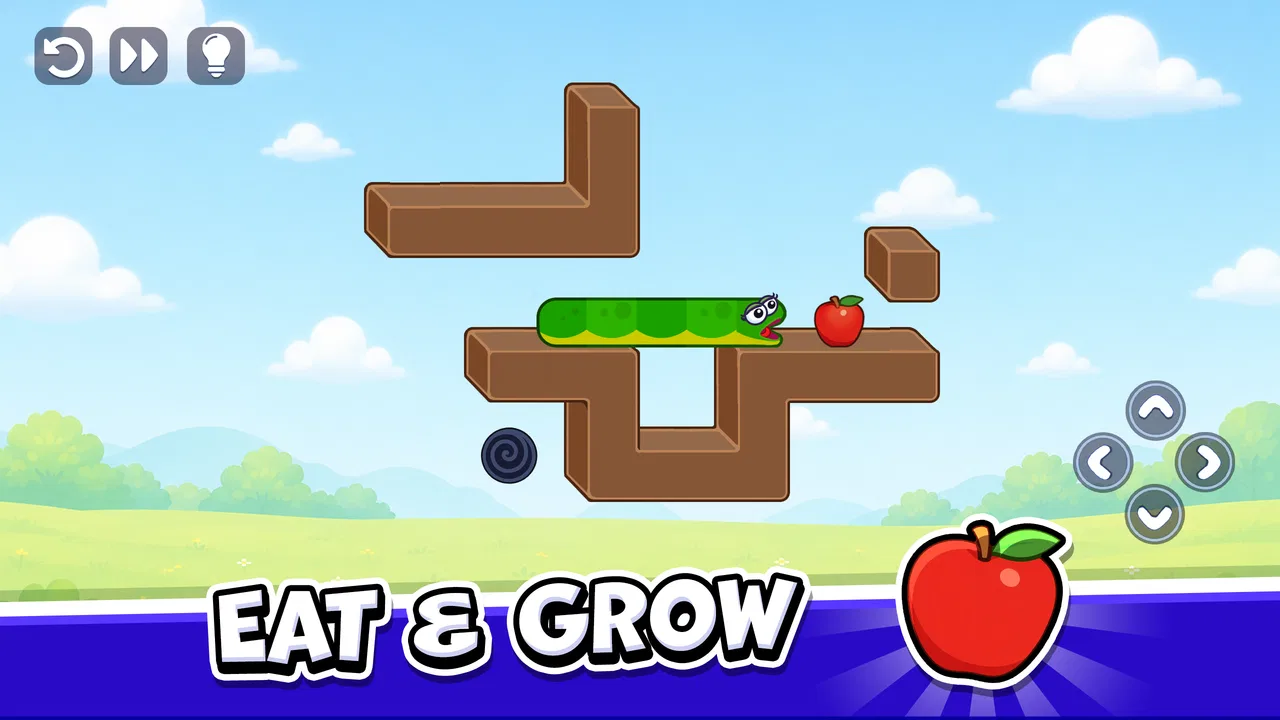
I approached Snake Puzzle: Slither to Eat expecting a familiar snake game, but the puzzle angle changes the way I play. The goal is not simply to keep moving and collect food. Each board asks me to think about direction, space, timing, and the consequences of making the snake longer. A move that looks helpful at first can leave the head trapped or make the next apple impossible to reach.
That makes this a good choice for someone who wants a light puzzle game that can be understood quickly but still rewards careful planning. It is free to download, rated for Everyone, and developed by Brave HK Limited. The game has reached over 10 million installs and holds a 4.5 average from around 99 thousand ratings, so it clearly appeals to a broad audience. My experience is that its strongest quality is the short decision cycle: I can start a level almost immediately, make a mistake, understand why it happened, and try again with a better plan.
What to expect when you begin
The store summary describes strategic slithering, apple eating, and puzzle solving, and that is a fair outline of the experience. The snake is both the tool and the obstacle. Eating an apple usually helps me progress, but growing also reduces the room available for future movement. The central challenge comes from managing that trade-off rather than rushing toward the nearest target.
You May Also Like

 Blood Strike: 2.5 Anniversary
Blood Strike’s Loadouts Turn Every Drop Into a Tactical Gamble
A close look at Blood Strike’s custom loadouts: how fast access to signature weapons reshapes its battle royale rhythm, rewards preparation, and narrows the gap between fights.

 Pandora - Music & Podcasts
Pandora’s Music Is Easy to Start, but Harder to Recover
Pandora’s strength is its low-effort path from a seed to a station. Its weak spot is how much confidence it asks you to place in connection, setup, and quiet recovery.

 8 Ball Pool
 Is Built on Rivalries, Rematches, and Routine
A close look at the rivalries, rematches, shared routines, and unanswered safety questions that turn a quick pool match into a persistent mobile community.

 Samsung Music
’s Quiet Strength Is Playing What You Already Own
Its reach comes less from spectacle than from dependable access to a personal library. That simplicity is both the app’s strongest retention engine and its ceiling.

 AccuWeather: Weather Radar
AccuWeather Review: A Quick, Clear Forecast for Everyday Decisions
For everyday plans, the best forecast is the one you can understand quickly. AccuWeather makes rain timing, radar, and local conditions easy to act on, with a few trade-offs.

 Hill Climb Racing
Why Hill Climb Racing Still Turns Crashes Into One More Run
A tiny car, a bumpy hill and one more upgrade: Hill Climb Racing keeps resurfacing because its simple chaos makes every near-miss feel personal.
More From Our News Desk



The presentation is easy to understand because the basic idea is familiar. If you have played a traditional snake game, you will recognize the movement immediately. The difference is that this feels more like a collection of compact logic problems than an endless survival session. I am not primarily chasing a high score by reacting quickly; I am looking for a route that leaves enough space for the next decision.
That distinction matters before you install it. Players who enjoy board puzzles, pathfinding, and trial-and-error challenges will probably settle in quickly. Players looking for a fast arcade game with constant action may find the slower planning rhythm less exciting. It is also not the best replacement for a deep strategy game, because the appeal comes from focused, bite-sized decisions rather than a large system of long-term progression.
The game is free, with in-app purchases ranging from $0.99 to $7.49 per item. I would treat those purchases as optional rather than part of the reason to try it. The free entry makes it easy to test the puzzle style without committing money first, while the purchase range is worth remembering if you are choosing a game for a child or trying to keep spending tightly controlled.
Why the familiar snake idea works as a puzzle
In a classic snake game, instinct often tells me to keep moving and grab whatever appears next. Here, that instinct can be exactly what causes a failure. The useful question is not “How do I reach the apple fastest?” but “Where will the snake be after I reach it?” That small change encourages me to inspect the board before touching the controls.
I also like that the game creates tension without needing complicated rules. A long explanation would weaken this kind of design. Instead, the board itself teaches the important lesson: open space is valuable, and a successful move can create a future problem. When I pause for a moment and map out two or three turns, the puzzles become much more manageable.
The most important early habit is to plan the exit from an apple before moving toward it. This is more useful than simply memorizing a route. I look at the squares around the target, consider how the snake’s body will occupy the board, and then choose an approach that leaves a continuation rather than a dead end.
Getting through the first setup without overthinking it
Because the game is designed around a straightforward snake-puzzle concept, the first setup should feel approachable. I would begin with a quiet environment and a few uninterrupted minutes rather than launching it while distracted. The opening boards are most useful when I treat them as a tutorial in movement logic, not as tests that must be solved perfectly on the first attempt.
My advice for a first-time player is to use the opening levels to learn how the game interprets each direction. Pay attention to whether a turn is accepted immediately, how close the snake can move to an edge, and what happens when the body blocks a route. These details are more important than speed. Once I understand the movement response, later failures feel like planning mistakes instead of control surprises.
I would also avoid spending anything during the first session. The free version gives enough room to decide whether the puzzle format suits you. If the game becomes a regular short break, then you can decide whether an optional purchase is worthwhile. Making that decision later is sensible because the main question is not whether the game looks attractive, but whether you enjoy repeatedly examining routes and correcting mistakes.
The age rating of Everyone makes it suitable for a wide audience, but that does not mean every player will find it equally comfortable. Younger players may enjoy the simple visual idea while still needing help with planning ahead. Adults who want a calming mental exercise may appreciate the low barrier to entry, although anyone who dislikes restarting after an avoidable mistake may find the trial-and-error structure frustrating.
Your first meaningful success
For me, the first real success is not merely eating an apple. It is solving a board while keeping a clear route for the next move. That is the moment when the game stops feeling like a familiar arcade imitation and starts working as a puzzle. I recommend aiming for that kind of success instead of trying to move quickly.
Before the first move, I scan the entire board. I identify the apple, note the available open areas, and imagine where the snake’s tail will be after each turn. Then I choose the route that preserves flexibility. If two paths reach the same target, I usually prefer the one that keeps the snake away from narrow corners until I know I will not need them later.
A useful technique is to think in short sequences rather than predicting the whole solution. I plan the next few turns, make them carefully, and then reassess the new position. This avoids two common errors: moving randomly because the full route seems unclear, or committing to a long plan that becomes invalid as soon as the snake grows.
When I fail, I try to identify the exact decision that caused the problem. Did I approach the apple from the wrong side? Did I use an open square too early? Did I turn into a corridor without a way out? Naming the mistake makes the restart productive. Simply repeating the same route usually produces the same result.
Common confusion that can make easy boards feel hard
The first confusion is assuming that the nearest apple is always the best target. Distance can be misleading. A short route may force the snake into a tight position, while a slightly longer approach can preserve room for the body and create a safer continuation. I learned to judge targets by the space they leave behind, not only by how quickly I can reach them.
Another problem is focusing only on the head. The head determines the immediate direction, but the body determines whether that direction remains possible. As the snake grows, every occupied square becomes part of the puzzle. I now check the body’s future position before turning, especially when the route passes near an edge or through a narrow section.
It is also easy to confuse patience with hesitation. Waiting too long to decide does not help if the game expects continuous movement, but rushing is worse when a single turn can close the board. I try to make each move deliberately while keeping the next decision in mind. The right pace is steady, not frantic and not frozen.
Some players may also expect the game to behave like an endless snake mode, where the main objective is survival for as long as possible. That expectation can lead to poor choices. I get more from it when I treat each board as a contained problem with a solution. The satisfaction comes from understanding the layout and improving the route, not from maintaining one uninterrupted run.
A further source of frustration is restarting without changing the plan. Puzzle games reward reflection, and this one is no different. After a failed attempt, I change one meaningful choice at a time. If I alter everything at once, I cannot tell which idea solved the problem. Small adjustments make the learning process clearer and help me build a reliable sense of how the boards work.
Practical habits for solving more consistently
My first habit is to reserve open space. I do not treat every empty square as an invitation to move there. Some spaces are strategically useful later, so I avoid filling or blocking them early unless the route requires it. This is especially important when the snake has already eaten and the board has become less forgiving.
My second habit is to approach an apple with the next turn in mind. I look for the landing position after eating rather than stopping my analysis at the target. If the head reaches the apple but the body blocks every useful direction afterward, the move was not truly successful. Thinking one step beyond the reward prevents many unnecessary restarts.
My third habit is to use the edges carefully. An edge can simplify a route by removing one possible direction, but it can also become a trap. I use it when I know the snake can continue along it or return to open space. I avoid entering a corner simply because it is close to the apple.
These habits make the game more approachable for a beginner, but they also reveal a trade-off. The more carefully I play, the less spontaneous the experience feels. That is not a flaw for puzzle fans, but it may be a drawback for someone who wants to switch off completely. The game asks for attention even when the rules are simple.
How it fits into everyday play
A realistic use case is a short break between tasks. I can open it, work through a compact puzzle, and stop after a successful attempt without needing to remember a large story or complicated control system. It suits moments when I want something more engaging than scrolling but less demanding than a long action game.
I can also see it working well for shared play with a child or a friend sitting nearby. One person can suggest a route while the other controls the snake, turning a simple board into a small discussion about consequences. The Everyone rating supports that broad accessibility, although I would still keep an eye on optional purchases if a child is using the device.
It is less suitable for commuting or situations where interruptions are constant if you personally dislike losing progress or restarting a puzzle. I prefer to begin a board when I can give it enough attention to understand the layout. The game may be simple to launch, but solving well still benefits from a few uninterrupted moments.
Where it stands beside other puzzle choices
Compared with match-three games, this offers less emphasis on quick pattern recognition and more emphasis on route planning. A match-three board often rewards spotting an immediate combination; this game asks me to think about how one move changes the available space. If you prefer rapid visual rewards, a match-three alternative may feel more energetic. If you enjoy consequences that unfold over several turns, the snake format is more satisfying.
Compared with traditional maze games, the snake itself adds a moving constraint. In a normal maze, I mainly search for a path from one location to another. Here, the path changes because the character occupies more of the board as it progresses. That makes the solution feel more dynamic, even though the controls remain simple.
Compared with endless arcade snake games, this is more deliberate and less dependent on reflexes. I would choose an endless alternative when I want continuous action, score chasing, or a familiar pick-up-and-play loop. I would choose this one when I want each attempt to teach me something about positioning. Neither style is universally better; they serve different moods.
The game also sits below large strategy titles in complexity. There is no need to learn a broad economy, manage a team, or follow a lengthy campaign before the puzzle becomes enjoyable. That simplicity is a strength for first-time users, but players seeking deep systems may reach its limits sooner than puzzle fans who enjoy compact logic challenges.
What the current release means for new players
The current version is 12.0.8, and the game supports devices running Android 7.0 or later. That makes it accessible to people using older Android hardware, provided the device meets that minimum requirement. Before installing, I would check the operating system rather than assume every older phone will run it.
The large install base and strong average rating suggest that the basic concept has connected with many players, but popularity should not replace personal fit. A high rating cannot tell me whether I enjoy planning around a growing snake. The best test is to play the early puzzles without rushing and notice whether the process of correcting a route feels rewarding or irritating.
I would also keep the purchase structure in mind when handing the phone to someone else. The game is free to start, while individual in-app items cost between $0.99 and $7.49. That does not automatically make the experience unsuitable for families, but it does make device-level purchase controls a sensible precaution.
Who should try it, and who should skip it
I recommend it to players who like compact logic problems, familiar mechanics with a twist, and games that reward thinking before acting. It is particularly approachable for someone new to mobile puzzle games because the snake idea is immediately recognizable. The first meaningful improvement comes from a simple change in behavior: look beyond the apple and plan the landing position.
I would also recommend it to people who want a low-commitment game for short sessions. There is no need to learn a complicated control scheme before deciding whether it is enjoyable. The free price makes experimentation easy, and the Everyone rating broadens its appeal across ages.
I would skip it if my priority were a story-driven adventure, a competitive multiplayer experience, or a fast arcade challenge built around reflexes. I would also look elsewhere if I became frustrated by retries or by puzzles that require me to reconsider an apparently good move. The game’s central pleasure is deliberate correction, so players who want constant forward momentum may not appreciate its rhythm.
My final recommendation after settling into the puzzles
Snake Puzzle: Slither to Eat works because it takes a familiar character and makes space management the real challenge. Once I stopped chasing the apple as quickly as possible, the boards became more interesting. I began to notice how the approach angle, the snake’s length, and the remaining open squares all affect the outcome.
For a first session, I would install it, play slowly through the opening boards, and judge it by the quality of the decisions rather than the number of puzzles completed. Scan before moving, keep an exit in mind, and treat each failed attempt as information. Those three habits make the path from installation to a first satisfying solution much less intimidating.
My overall view is positive, with a clear qualification: this is a focused puzzle game, not a universal replacement for every snake or casual game. Its free entry, approachable rules, and strategic movement make it easy to recommend to puzzle-minded players. Its reliance on patience and repeated attempts makes it a weaker match for anyone seeking instant action. If you enjoy watching a simple board become complicated through your own choices, Snake Puzzle: Slither to Eat is worth trying.
FAQs for Snake Puzzle: Slither to Eat
01What is Snake Puzzle: Slither to Eat about?
Snake Puzzle: Slither to Eat is a modern twist on the classic snake game, where players navigate a snake through various puzzles and challenges to eat food and grow longer. The game combines elements of strategy and quick reflexes, making it both engaging and addictive. It's available on both Android and iOS platforms.
02Are there in-app purchases in Snake Puzzle: Slither to Eat?
Yes, Snake Puzzle: Slither to Eat offers in-app purchases. While the game is free to download and play, there are optional purchases that can enhance your experience, such as unlocking premium levels, removing ads, or acquiring special skins for your snake. These purchases are not necessary to enjoy the game but provide additional features.
03What are the main features of Snake Puzzle: Slither to Eat?
The game features a variety of levels with increasing difficulty, unique puzzles, and vibrant graphics. Players can enjoy different game modes, earn daily rewards, and compete on leaderboards. The intuitive controls make it easy to play, while the challenging gameplay keeps it engaging for all ages.
04Is Snake Puzzle: Slither to Eat suitable for children?
Yes, Snake Puzzle: Slither to Eat is suitable for children. The game is designed to be family-friendly, with no inappropriate content. It encourages strategic thinking and problem-solving, making it an excellent choice for younger audiences. Parental guidance is advised for in-app purchases, ensuring a safe experience.
05Does Snake Puzzle: Slither to Eat require an internet connection?
Snake Puzzle: Slither to Eat can be played offline, making it convenient for users without a constant internet connection. However, certain features like leaderboards and daily rewards require an internet connection to function. Playing offline won't affect the core gameplay or your ability to enjoy the game.
Pros
- Intuitive controls for easy play.
- Variety of challenging levels.
- Colorful and engaging graphics.
- No intrusive ads during gameplay.
- Regular updates with new features.
Cons
- Occasional lag on older devices.
- Limited free hints available.
- Repetitive background music.
- Requires stable internet connection.
- In-app purchases can be pricey.

Snake Puzzle: Slither to Eat
Gallery